Categories

Showing posts with label Culture and Politics. Show all posts

Wednesday, March 30, 2011

CRITICAL COMMENTARY 5: Spaces

My Parents

My Dad

My father is calm. He exercises his power over me as a parent but respects my individual opinion as an adult. With my father, I am able to express my opinion and present my case in certain decision-making events in the family. As long as I remain respectful to his authority over me as my father, he will give me respect as well. He is the “rational” one in the family and he does his best to understand the context that I am coming from, using his own experiences in his youth to better understand me.


My Mom 

My mother is the go-getter. Her competitive spirit and Type A personality often reflects her being the “dominant” figure in the family. She will assert her point and opinion, until you prove her wrong--which is a rare case. She does not take things sitting down; her strong personality and feminist approach to life shows how she likes to take things into her own hands. It is difficult to win an argument with her, she will win 95% of the time


The Daughter
or as my dad calls it, the "doubter" 

Being the fist-born and eldest of 2 kids, much is expected from me.I have a lot of responsibilities at home, and I am able to exercise my power as an adult who is respected in the family. I am given a stake in the decision-making at home because of the responsibilities given to me, and how I earn their trust through my actions.

How my power relations with my parents affect my identity
I'd like to think that I got the best of both worlds. I hope I got part of the relational, understanding and rational aspect of my dad as much as I acquired my mom's assertiveness, competitiveness and strong "post-feminist" personality. At the end of the day, both parents have shaped my idea f "authority", respecting authority and what it really meant to question authority--in the most respectful manner, of course.


CRITICAL COMMENTARY 4: Carlos Celdran & Post-Colonialism

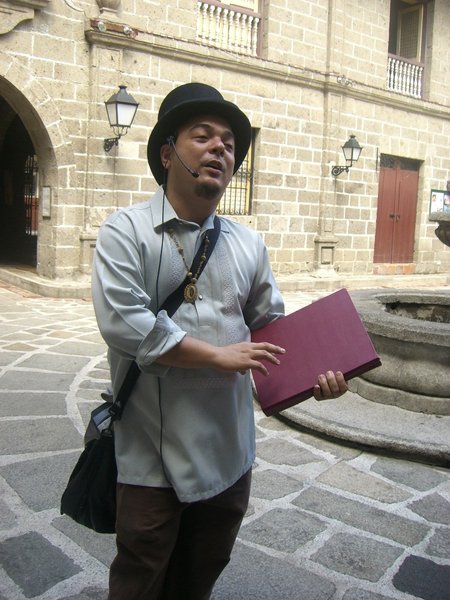
Carlos Celdran
Changing the way we see Manila

My first Carlos Celdran tour, back in 2007 with "Assumptionista Manindigan" Club

Of the many MANY things that Carlos Celdran was able to say with the few hours that i got to tour Intramuros with him, it was one thing he said that never left my mind, he said: 

"I cannot change the way Manila looks, but i can change the way you look at Manila"


Beyond the sarcasm and theatrics, I can personally attest to the fact that Carlos Celdran is not like any other tour guide i've encountered, both here and abroad. His choice of area and method of theatrics alone suggest that he was not like any other tour guide, and the fact that he is able to captivate and surprise even his own fellow Filipinos.  What is different about him is the fact that his tours do not showcase the latest developments or typical tour spots (now that he has become an icon, his tours are almost considered default to most Manila tourists), but chose a historic spot, one that (at the time he began his tours) was almost completely forgotten by the Filipinos themselves. He highlighted the Filipino colonial experience and helped explain why the Philippines is the way it is in status quo, dating everything back to its colonial roots.


In class, we discussed that "žžOne of the central features of post colonial theory is an examination of the impact and continuing legacy of the European conquest, colonization and domination of non-European lands, peoples and cultures" and that "decolonization process includes the reclamation and reconstruction of history and culture as the basis for the new post-colonial forms of nation and national identity" 

I believe that Carlos Celdran exhibits these perfectly because he reminds us that what we are is a major product of who has colonized us in the past, and he is a living example of one who continually attempts to establish that genuine Filipino identity through his tour guides, and in the process of such constant pursuit to find the true meaning of becoming Filipino, Carlos Celdran is becoming among those who are shaping the post-colonial identity and culture of the Philippines.

CRITICAL COMMENTARY 3: Indigenous Filipino Theories

Sikolohiyang Pilipino:
"Ningas Cogon"


In light of "Sikolohiyang Pilipino" being part of Indigenous Filipino theories and "Ningas Cogon" being a Filipino value that is a part of foreign constructions of the Filipino identity.

Ningas Cogon
"The popular Filipino phrase "ningas cogon" refers to the unnerving attitude of starting an initiative but fails to continue it, or the lack of a follow-up" (definition taken from here).

Have you ever noticed when scandals, whether showbiz-related or political in nature, start off with practically the whole country being "buzzed" about the issue, and then suddenly forgetting about it when the issue dies down? Take, for example, a political scandal with corruption allegations or a high-profile murder case, were such issues actually resolved? was justice served in both situations? and even if justice was actually served, are we actually fully aware about it?

The idea of a god start and a bad finish has always plagued the Filipino mindset. The fact that it is inherent in the filipino identity to lack that element of "following up" has had its own implications and consequences to major political events in Philippine history. Edsa Revolution is a classic example. Before I go further, I hope i do not offend anyone by my opinion on the Edsa revolution; it is, after all, just an opinion. 

Going back, the Edsa revolution has proven to become a classic example of this "Ningas Cogon" Filipino trait. We have started that trend, the surge of democracy that is from within, one that is brought about by the people trhough peaceful, non-violent and of course, democratic means. It is part of my pride of being Filipino that we are known for such an event (even if i was not alive to see it). but taking a step back and evaluating where Philippine democracy has gone from that point, what have we accomplished as a democracy, really? 

At the end of the day, that "follow up" which is ver much lacking in Filipinos is what brought us down. "We are good starters, and bad finishers"--I beg to disagree. We are good starters, and we do not finish at all. true change (especially in Philippine Politics) will only happen if Filipinos have that initiative AND follow up to stand for what they believe in, most especially in the context of a supposed functioning democratic society such as ours.

P.S. Whatever happened to Heidi Mendoza's testimony? It has hardly been 2 months and we almost already completely forgot about her and the issue at hand. ---this is EXACTLY MY POINT. Ningas Cogon.

CRITICAL COMMENTARY 2: On Post-Colonialism

Western Individualism & Eastern Collectivism


Before anything else, let me quote from the ever-reliable Wikipedia to define and create the parameters for my discussion:


Individualism
 "is the moral stance, political philosophy, ideology, or social outlook that stresses "the moral worth of the individual". Individualists promote the exercise of one's goals and desires and so independence and self-reliance while opposing most external interference upon one's own interests, whether by society, family or any other group or institution" (Wikipedia)


Collectivism
"is any philosophic, political, economic or social outlook that emphasizes the interdependence of every human in some collective group and the priority of group goals over individual goals. Collectivists usually focus on community, society or nation. Collectivism has been widely used to refer to a number of different political and economic philosophies, ranging from communism and democracy to totalitarian nationalism" (Wikipedia)


Individualism has been most linked to Democracy, Capitalism, Intellectual Property Rights, and many more. Such a concept has been most valued in the development of the western thought. Collectivism, on the other hand, has characterized confucianism, communism, bureaucracy and etc, which are mostly valued in Asia (or the east). 


In CULPOLI class, we discussed that "The history, culture, language, customs and beliefs of the white colonizers are to be considered as universal, normative and superior to the local indigenous culture of the colonized", and this is the case we see today. Time and time again, we read in the news that certain countries (which i feel i don't need to mention for you to understand) impose their beliefs by asserting that capitalism and democracy are applicable to other countries, that the western path to development is also applicable to countries whom they formerly colonize. 


I assert this point because I feel like in most cases, both perspectives fail to see that they all fail to realize the underlying fundamental universal values at stake when countries go to war with each other, impose sanctions, create economic barriers, and create unnecessary tension among states because most of them fail to see that the root of all differences in most international political conflict are the polarizing values between individualism and collectivism which are both prevalent in both the east and the west respectively. I believe that this is why there is still conflict, why countries and world leaders never see eye-to-eye and why some countries who adapt economic and political systems of those who have formerly colonized them are still in poverty, and why there are still not "developed" for international standards.


The link to Post-Colonialism


The post-colonial theory ž"Seeks to uncover the damaging effects of colonialism on both the self-identity of the colonized and the instability of the conceptual underpinnings of the colonizers", and in this sense i view international conflict as a product of western colonizers who still impose their belief systems to modern day post-colonial countries, thus, still hindering their development as countries independent from the control of other states.

Monday, February 21, 2011

CRITICAL COMMENTARY 1: The Personal is Political

On Feminism, Queer Theory & Post-Modern Feminism

The Glass Ceiling

I chose to do a critical commentary on this because of how personal Feminism is to me: as a female who struggles with the opportunities and limits brought about by her gender and someone who continually tries to go beyond the "glass ceilings"

"We are all bound by our conditionality" is a phrase that as a person of the female gender, and as a person who constantly strived to push boundaries, try to transcend, encompass and reject. I reject this phrase, but there are times where i feel that this phrase may hold some truths. 

out of all the discussions on feminism that we have learned in class, i can relate myself the most to ž“Beyond-bitch” Feminism—where women reject the whole masculinity-femininity duality, and by implication, their role as victims (as taken from the CULPOLI lecture powerpoint)


Let me start with an anecdote, one that is short but significant enough to change my whole perspective on the whole masculine-feminine paradigm. I was taking the course "Seminar on International Relations" under Mrs. Nikki Briones Carsi-Cruz, when me and a few friends volunteered to report on Feminism as an  issue in the international political arena. We knew one of our professor's specialties was Feminism, and that reporting such a topic would only "brush through the surface" of something she has a deep understanding on, but we were still determined. We prepared videos, anecdotes, graphs, extra resources in our presentation and we were confident that we would give justice to the readings and the coverage given to us. Our report was concise, the flow was logical, it was rational and orderly; the ideas properly categorized and organized, or so we thought. It was time for our presentation and despite the lingering feeling of nervousness, we were pretty much happy and content with our report, as it is a product of our hard work. We were surprised to get a negative response from our professor, and we were told to do the report again, with more feelings and with a personal touch. I didn't understand her point entirely, so my group and I added pictures, videos and more anecdotes to aid in our presentation, while the logical and rational flow of the report remained the same. We presented for the second time and Mrs. Carsi-Cruz was still not satisfied, and our group was so frustrated that it brought us to tears in front of the whole class. 

We talked to our professor and realized that even in the way we think and process knowledge has a very masculine approach (the logical, rational, analytical and compartmentalized approach to thinking), which makes the feminine approach (emotional, personal, interconnectedness and abstract approach to thinking) has been outnumbered and even marginalized. The fact that even without knowing it, and merely thinking in a certain way, i am contributing to the oppression of the essence of what is known to be feminism makes me question and re evaluate what other day-to-day practices i have that have a bias towards the masculine. All my life, i have been competitive and much of what has driven me to work hard, was that desire to achieve excellence in whatever i have done. in the process of such a pursuit, i have observed and adapted to the environment and practiced what i saw to help pave the way for success and give one an upper hand and  edge over everyone else. the mere academic trait of being logical and categorical (which i have adapted and strived to perfect) is masculine in itself, and biased, marginalizing the feminist way of thought.

The queer theory is something that i can personally identify with, at an intellectual context, my mind can be seen as "bisexual". There is a struggle for me to conform to what is accepted in society and viewed as qualities that allow one to get an upper hand, the qualities needed to excel and to be the best and to stay true to my being a female being, where feminist theorists would argue that being emotional, recognizing the interconnectedness and unpredictability of certain outcomes as primarily feminist qualities. For me, it has always been sort of an identity crisis, one which i have always had struggles with; to adapt, or to stay true to my gender's qualities?

Being an avid reader of magazines like TIME and The Economist, I came across an article entitled "Womenomics"(click here for article) dated almost 2 years ago. This looks at feminism in the context of the workplace and the corporate world. Based on my own understanding, the article has 2 main arguments:

1. Feminist's perspectives have changed over time, from what used to be the belief that women should be judged on the same standards as those used on men have now significantly shifted to today's influential and famous feminist's belief that it is no longer enough and women will never be able to be equally judged with the same standards as men, and that a complete restructuring and removing the "inherent sexism in corporate structure", because women are different from men.

2. Despite what these women may think, feminist qualities are actually becoming more valuable and considered an asset and an advantage in the corporate and business world, as evidenced by the financial crisis which reflected decisions made by people who have used masculine qualities such as rick taking and etc.

I would like to think of this as a phenomenon that is about to mature and full blown in the near future, as the trend of democracy in the world has become so widespread, it is my personal dream to see women succeed in whatever field without the burden of dealing with the imposed limitations by their own gender, strengthened by sexist and biased view of society. After all, as Mr. Contreras said, feminist cultural studies is also about making the invisible, visible.

Sunday, February 6, 2011

Post-Modernism & the Internet

2 arguments on post-modernism remain in my mind from the time i heard it in class, and until now as i type this blog post. The first is that modes of information has replaced the modes of production as the lynchpin for social development. The second is the claim that Society is increasingly "simulated"; that is, "conjured, in images and discourses that substitute for people's experience of a hard and fast reality."

After hearing these two arguments, the first thing that popped into my mind was the internet; the idea of information being at the tip of your fingers, within seconds, and the fact that it is so widespread and almost universal makes it undeniably "post-modernist" (in my thinking, at least). But being the reasonable and logical person that i am, aided by the habit of research that i have acquired throughout college and the need for me to bank on concrete evidence to justify my own claims, i went on and researched on the connection and significance between post-modernism and the internet. 

In the pursuit of knowledge that will help me link both concepts, i am left plagued with the following questions: 1. Can the post-modernist theory adequately explain the phenomena that is the internet? 2. Is the internet an evident, concrete manifestation of the post-modernist theories? 3. What does post-modernism day about the internet? is it a force for good, or a force for evil in society? 


I found a study named "A Postmodernist Study of the Internet", by Michael S.H. Heng of Vrije Universiteit Amsterdam. The title itself is very self-explanatory, and felt like a godsend to me as it directly addresses my inquiry on the relationship between post-modersnism and the internet and that the process of acquiring such information only took a few type searches on google.  ironic? comical? i'd like to think of it as more of the latter. and a little of the former.  

The study i found has had the following conclusions that highlight the paradox  of the internet in relation to post-modernism:

FIRST: There are two conflicting dimensions of the internet: "As a technology, the Internet has opened new pastures of opportunity for those who are not in the seats of established power and wealth" (Heng, 1998). & "Anderson (1996) observes that “software is a booming industry controlled by giants" (Heng, 1998). Despite the free-flow of information, absence of hierarchies, more opportunities for networks to organize, we can still see that the the "big guns" control the industry", and in the presence of claiming "internet is a form of anarchy", control is still found to be exercised even in the cyber world. which i find quite ironic. this point is synthesized in this statement: 

"Though recognising the fact that postmodemism is deconstructionist, and with the Internet, there are new avenues of opportunity for those not in power or wealth to voice protest, we must not lose sight of the fact that real powers are still strongly entrenched" (Heng, 1998).

SECOND: The argument of post-modernism having information as an element that paves the way for development (as it is told in class by Mr. Contreras), this study has found that such a claim does not always hold true for the internet:

"Floridi (1996) observes that the Internet is fostering the growth of knowledge, while at the same time generating unprecedented forms of ignorance. While the Net provides a platform for dissident political groupings to spread their otherwise suppressed views, it also acts as a channel for racist, sexist and fascist groups to peddle their goods" (Heng,1998).

after what i have found, and based on my initial questions on the topic, i have found that: 1. In the presence of many paradoxes found in the internet, the post-modernist theory cannot adequately explain the internet phenomena. 2. The internet is not an evident manifestation of the post-modernist theories. while it may have many qualities that are no coincidence to the claims of post-modernism, the paradox in paradigms seen in the internet shows us that there is more to the internet than its resemblance to the post-modernist theory. 3. although it may show positive societal impacts, the internet is not all good and may have its negative effects, as seen i the two arguments found in the study.

References:

Heng, M. S. (1998). A Postmodernist Study of the Internet. Vrije Universiteit Amsterdam, Faculty of Economics. Amsterdam: Vrije Universiteit Amsterdam.

ON A LIGHTER NOTE, here's a funny video i found on the internet that serves as a paradox in itself: How the internet as a sources of information has replaced the normal modes of production such as newspapers and magazines, but also how there are some things that technology cannot replace. 


Wednesday, January 26, 2011

"Art for the masses has destroyed the dream"

on Western Marxism & Culture Industries

(blog title "Art for the masses has destroyed the dream" taken from video below)

It was once said that religion was the "opium of the masses", and i just recently realized that the same analogy can be applied to the media. the idea that the media reaffirms the dominance of the status quo, the picture of the "good society" that the media paints and all the perception that comes with the implications of a barely educated audience (especially in the Philippine setting) whose past time is the television, the commodification of culture used for culture industries and capitalism, the "bahala na" and "crab mentality" message of Philippine soap operas are all manifestations and CONFIRMATIONS of the frankfurt school theories of Adorno, Gramsci, Lukas, Marcuse. etc.

In my pursuit to understand more about this theory and its manifestations, i came across a video about culture industries in the form of a music video with very interesting lyrics:

"love reduced to romance in the culture industry..."
"happiness reduced to laughter...in the culture industry..."
"through the filter of the Culture Industry, the only thing acceptable is meaninglessness"
"the consciousness of God is replaced by the production team"


personally, i though the video was very peculiar, but there are certain things to be reflected on when i first heard the lyrics: does commodifying culture reduce its meaning? this brought me back to the idea of being "indie" and "hipster", where urban dictionary defines them as:

Indie
"By this definition, indie is any business or designer that is not associated with a large company. Indie can also define the consumer who chooses to support small business, independent record labels and handmade items rather than shopping at big-box stores." (urbandictionary.com)

Hipster
"Hipsters reject "mainstream" culture and embrace and contribute to independent culture, and prides him/herself on this...  Usually has some degree of monetary conformability, although sometimes only because of their parents, due to cost of living in these areas... Has "elitist" taste.. walks among the masses in daily life but is not a part of them and shuns or reduces to kitsch anything held dear by the mainstream.." (urbandictionary.com)

these words are usually related to the feelings of being "above the mainstream" or the common norm, those who have the time and resources to gain access to films, music, art, literature and etc that are not readily available to the public. this reminded me of Mr. Contreras' argument in class of how the socio-economic elite are those who tend to stray away from the culture of the masses, as they have more resources to spend on other hobbies and past times which they can readily afford (e.g. the opera, museums, equestrian, cable TV and many more). 

i can cite more contemporary examples and manifestations of this theory, but at the end of the day it is up to you (readers out there, if there are any) to decide whether or not society (Philippine society to be more specific) is conditioned and bound by such theoretical claims.

Good night, all! till my next blog post.

Wednesday, January 12, 2011

Regular Political Compass & Identity checks

for Mr. Contreras: to filter all my CULPOLI-related blog posts, just click on the "Culture and Politics tab" above the blog posts.  
^^^ Up there ^^^ 
Thank you 

[first blog post for my Culture and Politics class]

Political Compass

we started our first class with our professor  asking us a few yes/no  questions which at the end labeled us as either conservative or liberal in certain political and social issues. My answers reflected my being  conservative on political issues and my being liberal on social issues. We were then asked if we were aware of our positions or if they have changed through time. 

Like a regular check-up with the doctor, I used to always check my position in the political compass because as a political science major & a legislative assembly representative for my batch in the student government i felt that it was my responsibility to always be up to date with my own views, ideals and stands on certain issues for me to be able to be honest to myself and everyone else (most especially my constituents). It's been a while since i last checked my position in the political compass so i took the test again and here's what i got:


Not much has changed, I have always been on the right in terms of the economic dimension (if you were my friend you would know how much of a staunch believer i am of neo-liberalism/capitalism); i'm all for open economies, globalization and letting the market decide for itself. What has changed though, is my position towards the social dimension, it seems that i am now (.20 units) closer to authoritarianism;  this could be explained by my positions on morality and capital punishment that have recently changed. Apparently my position in the political compass is closest to that of Angela Merkel's, the current chancellor of Germany. I don't know if i should take this as a compliment or if i should be worried and start re-evaluating my beliefs. Nevertheless, i'm all for successful and powerful women so i guess i should take it as a plus.

Identity

We discussed about knowing ourselves, and how structures, norms, family, ideas, memes and many other components of culture and society have contributed to who we have become and in the formation of our identity. What made me think was the question about oppression, objectification and power relations. I have always been one to challenge authority and resist power, but only when i felt it was necessary and if i could very well justify it. I am someone who respects power in general but i question and abhor the seniority-based pyramidical hierarchies that most often deny those who are capable and qualified of getting fair chances with those who are their "seniors".  Objectification was also something to think about for me, where i learned that objectification is not merely making someone feel inferior, but goes as far as denying that person to make a choice for his/her own; this is something that i sometimes unconsciously exercise, something that i should seriously evaluate and become more conscious of.